
SIS House, NH6 Uttar Nibra, Howrah - 711409, (W.B), India
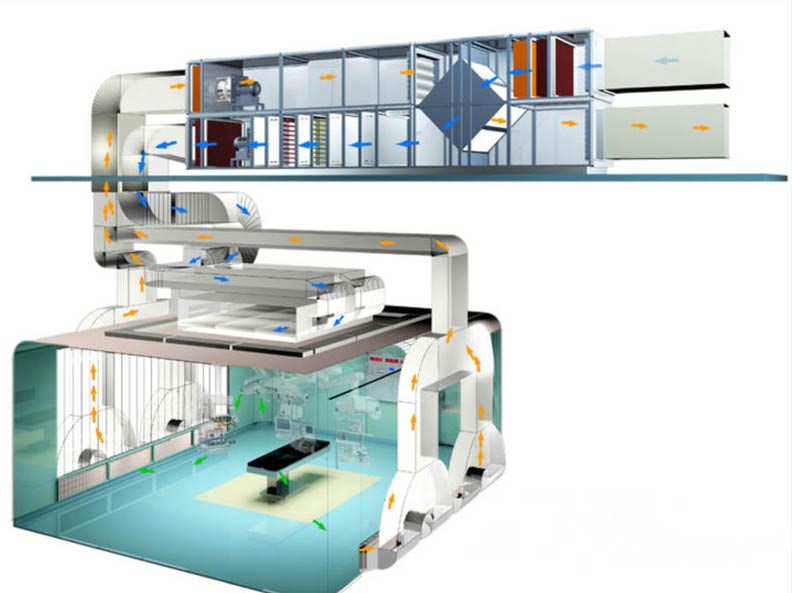
It generates a sterile air blown into the critical protection area in a vertical laminar manner, the size of laminar airflow ceiling is based upon the space required for surgery type, the staff and devices and equipment needs.
The frame is made in SS304 1.2mm with bottom performable to ensure laminar air flow.
In fluid dynamics, laminar flow (or streamline flow) occurs when a fluid flows in parallel layers, with no disruption between the layers. At low velocities, the fluid tends to flow without lateral mixing, and adjacent layers slide past one another like playing cards. There are no cross-currents perpendicular to the direction of flow, nor eddies or swirls of fluids. In laminar flow, the motion of the particles of the fluid is very orderly with particles close to a solid surface moving in straight lines parallel to that surface. Laminar flow is a flow regime characterized by high momentum diffusion and low momentum convection.
Patients undergoing invasive procedures are more susceptible to surgical site infections by 14% to 17% of all hospital-acquired infections. Air distribution in an operating room plays a critical role for the safety of the patient and surgery team while providing a comfortable working environment.
The three primary sources of airborne particulates in clean environments are from infiltration, contamination by occupants and from ventilation systems.
The air in operating theatres should be kept at a higher pressure than in corridors and adjacent areas. This positive pressure prevents the flow of air from less sterile areas into more sterile ones.
Particulates from occupants can be controlled and reduced by adopting a logical and carefully examined process whereby specific rooms are designated for performing surgical procedures and for processing instruments and other items. It is also important to control traffic and activities in these areas since the number of people and the amount of activity influence the number of microorganisms that are present on occupants and therefore influence the risk of infection.
Finally, high efficiency (HEPA) filters used in ventilation system such as Laminar Air Flow are common and most efficient method to reduce surgical site infections. From a purely technical standpoint,
systems that provide laminar flow regimes constitute the best option for an operating theatre, in terms of contamination control, as they result in the smallest percentage of particles impacting the surgical site.
The reason for this is that such systems supply a controlled, constant column of air to the surgical site area; this is effective in sweeping contaminants from the surgical site area, where they might otherwise be deposited.
Our ceiling laminar air flow distribution system is designed with low velocity to:
• Provide high volume laminar stream of clean air.
• Maintain a comfortable environment.
• Control the particulate with high efficiency filters.
• Reduce entrainment of air within the operating theatre.
• Eliminate inhibiting of dust using double-layered laminar membrane.
• Eradicate the chance of plenum contamination using air tight construction.
The main goal of any good Laminar Air Flow system is to supply clean laminar air over the surgical site with minimal turbulence, providing a comfortable environment and minimizing the risk of surgical site infection.